Buying gold online or surprising someone with a gift is wonderful, until the bangle will not slide over the hand or the ring spins loose on the finger. Getting your gold bangle and gold ring size right at home saves you the cost and hassle of returns, resizing charges, and disappointment. The good news is that you do not need special tools. With a measuring tape or a piece of thread, a ruler, and a few minutes, you can measure accurately from your own home.
This guide walks you through simple methods for both bangles and rings, along with size charts and tips to get the most reliable result. Take your time, measure more than once, and you will buy with confidence. Whether you are sizing for yourself or quietly measuring for a gift, the steps are the same and take only a few minutes.
Why Getting Your Gold Bangle and Gold Ring Size Right Matters
A correct fit is about more than comfort, though comfort certainly matters. A bangle that is too small will not pass over the hand, while one too large slips off and risks being lost. A ring that is too tight is hard to remove, and one too loose can slide off without you noticing.
There is a financial side too. Resizing a gold ring or adjusting a bangle often involves extra charges, and not every design can be altered easily. Intricate or stone-set pieces are especially hard to resize without affecting the work. Measuring well the first time protects both the piece and your wallet.
This matters most when buying online, where you cannot try before you buy. An accurate home measurement, checked against a reliable size chart, is your best substitute for slipping the piece on in a showroom. Get it right, and your gold will fit beautifully from the moment it arrives, with no anxious wait for a resize or return.
What You Need Before You Start
You only need a few simple items, all likely already in your home:
- A flexible measuring tape, or a strip of thread or paper if you do not have one.
- A ruler marked in millimetres and centimetres.
- A pen to mark the thread or paper.
- An existing bangle or ring that already fits well, if you have one.
- A printed size chart, or the charts below for reference.
Have these ready before you begin, and work in good light. A calm, unhurried few minutes gives far better results than a rushed guess, and having everything to hand means you will not lose your place halfway through.
How to Find Your Gold Bangle Size at Home
Bangles are sized by the inner diameter, but the easiest way to start is by measuring your hand. Here are two reliable methods.
Method 1: Measure Your Hand
Bring your fingers and thumb together as if slipping on a bangle, making the hand as narrow as possible. Wrap a measuring tape or thread around the widest part of this folded hand, usually across the knuckles and thumb joint. Note the measurement in centimetres. If you used thread, mark where it meets and measure that length against your ruler.
This circumference corresponds to a bangle size. A careful gold bangle size measurement here is the foundation, so take it two or three times and use the largest reading, since the bangle must pass over the widest point of your hand. Pulling the tape too tight is a common error, so keep it firm but natural, the way a bangle would actually sit as it slides on.
Method 2: Measure an Existing Bangle
If you own a bangle that fits well, measure its inner diameter instead. Lay it flat and measure straight across the inside, from edge to edge, in millimetres. This inner diameter maps directly to a standard size, and it is often the most accurate method since it reflects a fit you already know works. Choose a bangle you can both slip on easily and wear comfortably, as that is the fit you want to repeat.
Gold Bangle Size Chart
Use this gold bangle size chart to convert your measurement to a standard Indian bangle size. Hand circumference and inner diameter both point to the same size number.
- Size 2.4: inner diameter about 6.1 cm, hand circumference about 19.5 cm.
- Size 2.6: inner diameter about 6.5 cm, hand circumference about 20.5 cm.
- Size 2.8: inner diameter about 6.9 cm, hand circumference about 21.5 cm.
- Size 2.10: inner diameter about 7.3 cm, hand circumference about 22.5 cm.
Most adult women fall between size 2.4 and 2.8. If you land between two sizes, consider how easily the bangle must pass over your hand and lean toward the larger option.
How to Find Your Gold Ring Size at Home
Rings are sized by the inner circumference or diameter of the band. As with bangles, you can measure your finger directly or measure a ring you already own.
Method 1: The Thread or Paper Strip Method
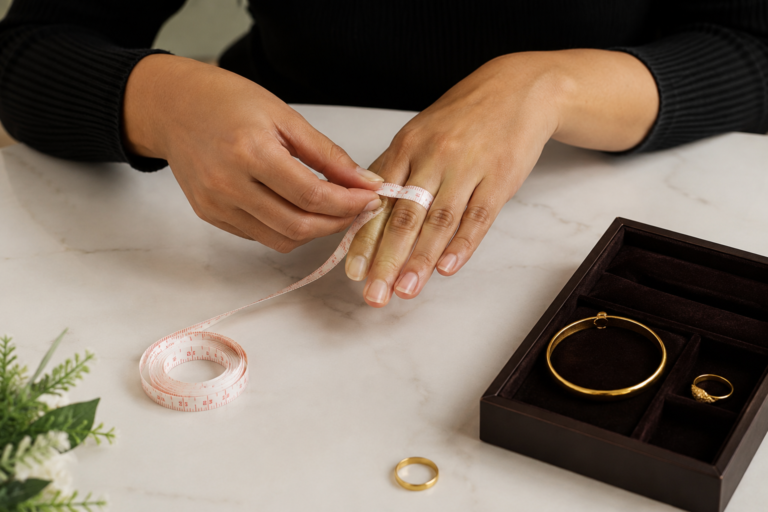
Wrap a thin strip of paper or a length of thread around the base of the finger you intend to wear the ring on. Mark the point where it overlaps, then lay it flat against your ruler and note the length in millimetres. This is your finger circumference, which maps to a ring size.
Make sure the strip is snug but not tight, and remember to check that it can pass over your knuckle, since the knuckle is often wider than the base of the finger. If the knuckle is much larger, measure there too and choose a size between the two. This balance keeps the ring easy to put on while still sitting securely at the base.
Method 2: Measure an Existing Ring
If you have a ring that fits the right finger well, measure its inner diameter across the middle in millimetres. This diameter converts directly to a ring size and is a dependable method because it reflects a known, comfortable fit.
Gold Ring Size Chart
Use this gold ring size chart to convert your measurement to a standard Indian ring size. Both finger circumference and inner diameter are shown.
- Size 10: inner diameter about 15.3 mm, circumference about 48 mm.
- Size 12: inner diameter about 16.1 mm, circumference about 50.5 mm.
- Size 14: inner diameter about 16.9 mm, circumference about 53 mm.
- Size 16: inner diameter about 17.8 mm, circumference about 55.5 mm.
- Size 18: inner diameter about 18.5 mm, circumference about 58 mm.
If you fall between two sizes, the right choice depends on the band. A wide band fits more snugly, so size up slightly, while a thin band can take the smaller size.
Tips for Getting the Most Accurate Measurement
A few simple habits make your measurements far more reliable. These small details are what separate a perfect fit from a frustrating one.
- Measure at the end of the day, when hands and fingers are at their largest. Morning measurements can run small.
- Avoid measuring when you are cold, since fingers shrink and you may end up with a ring that is too tight in warm weather.
- Measure two or three times and take an average, or the largest reading for bangles that must clear the hand.
- Account for the knuckle on rings, choosing a size that slides over it comfortably.
- Use the dominant hand’s measurement if sizing for that hand, as it is often slightly larger.
Taking these steps removes most of the guesswork. When your numbers are consistent across a few attempts, you can trust the size you have landed on.
When to Visit a Jeweller Instead
Home measuring works well for most purchases, but some situations call for professional help. Very wide or comfort-fit rings sit differently and often need a specific size that home methods can miss. Heavy or rigid bangles, and anything custom or high-value, are also worth getting professionally measured.
If you are unsure or fall awkwardly between sizes, a quick visit to a trusted jeweller settles it. A proper ring gauge and bangle sizer give an exact result, and for an important or expensive piece, that certainty is well worth the short trip. Many jewellers will also record your size for future purchases, which makes buying or gifting easier down the line.
Finding your correct gold bangle and gold ring size at home is simple once you know how. With a measuring tape or thread, a ruler, and a reliable size chart, you can measure accurately in minutes and avoid the cost and disappointment of a poor fit. Measuring an existing piece that already fits is often the easiest route, while the thread and hand methods work perfectly when you are starting from scratch.
Remember to measure carefully, more than once, and at the right time of day, and to size up where a piece must clear a knuckle or a wider hand. For anything heavy, wide, or high-value, a quick check with a jeweller adds final certainty. When you are ready to buy, an accurate size means your gold from Charvi Jewels will fit beautifully from the very first wear.
Frequently Asked Questions
Bring your fingers and thumb together as if sliding on a bangle, then wrap a measuring tape or thread around the widest part of your hand. Measure that circumference in centimetres and match it to a bangle size chart. Take the reading two or three times for accuracy.
Wrap a thin strip of paper or thread around the base of your finger, mark where it overlaps, and measure the length in millimetres against a ruler. Match that finger circumference to a ring size chart. Check it passes over your knuckle comfortably before deciding.
Most adult women fall between size 2.4 and 2.6, though it varies by hand size. The only way to be sure is to measure your own hand circumference or an existing bangle that fits well, then match it to a reliable bangle size chart.
Measure at the end of the day, when your fingers are at their largest. Fingers tend to be smaller in the morning and when cold, which can lead to a ring that feels too tight later. Measuring warm and late gives the most reliable result.
For rings, it depends on the band: a wide band fits snugger, so size up, while a thin band can take the smaller size. For bangles, lean toward the larger size, since the bangle must slide over the widest part of your hand.
Take a ring that fits the intended finger well and measure its inner diameter straight across the middle in millimetres. Match that figure to a ring size chart. This method is dependable because it reflects a fit you already know is comfortable.
Yes. Wider bands cover more of the finger and feel tighter, so you often need to size up slightly for comfort-fit or broad designs. Thinner bands sit more loosely, so your standard size usually works. Mention the band width when ordering if unsure.
Not always. Plain bands and simple bangles are usually easy to resize, but intricate, stone-set, or patterned pieces can be difficult or impossible to alter without affecting the design. This is exactly why measuring accurately before buying matters so much, especially for detailed pieces.
Thread or paper-strip measuring is surprisingly accurate when done carefully. Keep the strip snug but not tight, mark the overlap precisely, and measure against a millimetre ruler. Repeat two or three times for consistency. For high-value pieces, confirm with a jeweller’s gauge before buying.
Bangles are rigid and must slide over your whole hand, not just sit on the wrist. That is why you measure the widest part of your folded hand rather than your wrist. A bangle sized only to the wrist will not pass over the knuckles and thumb joint.