
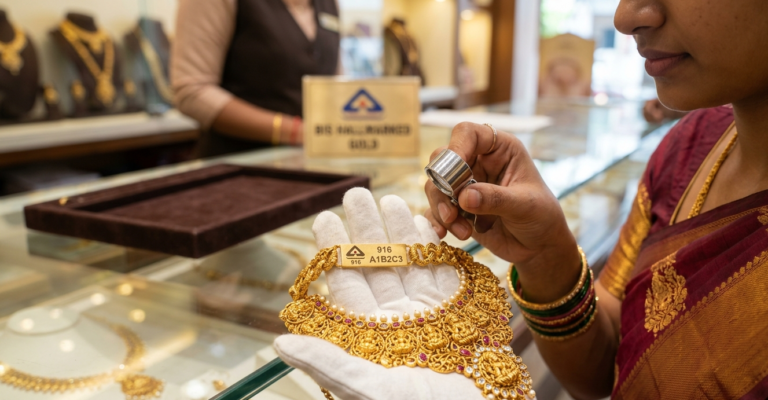
Every family in Coimbatore has that one memory. Someone bought gold for a wedding, paid a full price, and only discovered years later that the purity was not what the jeweller had promised. It is a painful experience, and it is far more common than most people admit. Gold purity fraud is real. It is not dramatic or rare. It happens in quiet, ordinary ways: a slightly inflated karat claim, a missing hallmark, a bill that does not clearly mention the purity of the metal.
The good news is that protecting yourself is not difficult. You do not need to be a goldsmith or a gemologist. You just need to know what to look for, what questions to ask, and which signs to trust. This blog gives you all of that in simple, clear language so that every rupee you spend on your wedding gold is spent with complete confidence.
Why Gold Purity Matters More Than You Think When Buying Wedding Gold
When a bride in Coimbatore sits down to plan her wedding jewellery, purity is rarely the first thing on her mind. She is thinking about designs, about which necklace will complement her Kanjivaram saree, about how many bangles she needs for the muhurtham. Purity feels like a technical detail. But it is actually the most important detail of all.
Here is why. Gold purity directly determines the value of everything you buy. A necklace sold to you as 22K gold is priced as 22K gold. If it turns out to be 20K or 18K, you have paid a higher price for a lower-quality product. Over a full bridal jewellery set, that gap in purity can represent a very significant financial loss, sometimes running into several thousand or even tens of thousands of rupees.
Purity and the South Indian Bridal Context
In South Indian wedding culture, gold is not just jewellery. It is a form of wealth transfer from one generation to the next. The thali tied during the muhurtham, the bangles exchanged as part of the ceremony, the necklaces and earrings gifted by both families: all of these carry monetary value alongside their cultural significance. When that gold eventually passes to the next generation or is taken to a jeweller for exchange or redesign, its purity will determine exactly how much value it holds.
A strong gold purity check habit protects not just your wedding budget today, but the financial legacy that gold represents for your family across generations.
The Difference Between Karat and Purity Percentage
Understanding karat is the first step in any Gold Purity Check. Many brides hear these terms without fully understanding what they mean:
- 24K gold: 99.9% pure gold. Too soft for jewellery. Not used in standard jewellery making.
- 22K gold: 91.6% pure gold. The standard for traditional South Indian bridal jewellery.
- 18K gold: 75% pure gold. Used for diamond-studded jewellery and modern designs.
- 14K gold: 58.3% pure gold. Less common in Indian jewellery markets but found in some imported pieces.
When you walk into a jewellery store and ask for 22K gold, you are asking for jewellery that is 91.6% pure gold and 8.4% alloy metals. Any deviation from that standard, even a small one, affects both the colour and the value of the piece. This is why the ability to verify purity is such a critical buying gold jewellery tip for every bride and her family.
The Emotional Cost of Getting It Wrong
Beyond the financial loss, there is an emotional dimension to this issue. Wedding gold carries memory. It is worn on one of the most sacred days of a woman’s life. Discovering later that the gold was not pure feels like a betrayal of something deeply personal. No bride should have to carry that burden. Knowing how to verify purity before you buy is the simplest and most effective way to protect both your investment and your peace of mind.
The BIS Hallmark System and How to Check Gold Purity Using It
The single most reliable method for verifying gold purity in India is the BIS hallmark. BIS stands for Bureau of Indian Standards, and it is the government body responsible for certifying that gold sold in India meets declared purity standards. Since 2021, it has been mandatory for gold jewellers in India to sell only BIS hallmarked gold jewellery. This law exists specifically to protect buyers like you.
Understanding the hallmark system is the most important buying gold jewellery tip you can carry with you when you go shopping. Once you know what to look for, you can verify purity yourself in seconds.
What a BIS Hallmark Looks Like
A complete BIS hallmark on a gold piece contains the following marks, usually stamped in a small area on the inside surface of the jewellery:
- The BIS logo: A triangle-shaped mark that indicates the piece has been certified by the Bureau of Indian Standards
- The purity or fineness number: This is the three-digit number that tells you the gold content. Common numbers are:
- 999 for 24K gold
- 916 for 22K gold
- 750 for 18K gold
- 585 for 14K gold
- The HUID number: This is the Hallmarking Unique ID, a six-digit alphanumeric code introduced in 2021. Every individual piece of hallmarked jewellery has its own unique HUID.
How to Use the HUID for a Gold Hallmark Check
The HUID system is one of the most powerful consumer protection tools available to Indian gold buyers today. Here is how to use it for a gold hallmark check:
- Find the HUID number stamped on the jewellery piece (use a magnifying glass if needed, as the stamp is small)
- Visit the BIS Care app or the BIS official website
- Enter the HUID number in the designated field
- The system will display the registered details of that specific piece, including the jeweller’s name, the purity, and the hallmarking centre that certified it
If the HUID number does not appear in the BIS system, or if the details do not match what the jeweller has told you, that is a serious red flag. A genuine gold hallmark check using the HUID gives you instant, government-verified confirmation of the purity of the piece in your hands.
Where the Hallmark Is Stamped
On different types of jewellery, the hallmark is stamped in different locations:
- Necklaces and chains: On the clasp or on a small flat section near the clasp
- Bangles and kadas: On the inner flat surface of the bangle
- Rings: On the inside of the ring band
- Earrings: On the post or the back of the earring
- Pendants: On the loop or the back surface of the pendant
Always check for the hallmark physically before finalising any purchase. Do not accept a jeweller’s verbal assurance as a substitute for seeing the stamp yourself.
Simple At-Home Methods Every Coimbatore Bride Should Know for a Basic Gold Purity Check
The BIS hallmark is your strongest protection, but there are also some basic methods that can help you do a preliminary gold purity check at home or in the store before the hallmark verification. These are not substitutes for hallmarking, but they are useful as a first layer of observation.
The Magnet Test
Gold is not magnetic. This is a straightforward physical property of the metal. If you hold a strong magnet near a piece of gold jewellery and the jewellery is attracted to the magnet, the piece contains magnetic metals like iron or nickel. This means the gold content is either very low or the piece is not genuine gold at all.
However, keep in mind that the magnet test has limitations. Many non-gold metals, including copper and zinc, are also non-magnetic. So a piece passing the magnet test does not confirm it is pure gold. It only rules out the presence of highly magnetic base metals.
The Skin Discolouration Test
Pure gold does not react with skin. If a piece of jewellery leaves green, black, or blue marks on your skin after wearing it for a few hours, that is a sign that the metal contains a high proportion of alloy metals reacting with your skin’s acidity and moisture.
22K gold, because it is 91.6% pure, rarely causes skin discoloration in normal conditions. If a piece sold to you as 22K is leaving marks on your skin, it is worth having the purity verified professionally. This is one of the most practical buying gold jewellery tips for anyone who has already purchased gold and wants to check its quality at home.
The Ceramic Scratch Test
This is a simple visual test. Scratch the gold piece gently across an unglazed ceramic surface such as the back of a ceramic tile or plate. If the piece leaves a golden streak, the gold content is likely genuine. If it leaves a black streak, the piece may be gold-plated or contain a high proportion of base metals.
This test does leave a very faint surface mark on the jewellery, so use it only as a last resort or on a part of the piece that is not prominently visible.
The Float Test
Pure gold is extremely dense. It sinks immediately in water. If you drop a piece of gold jewellery into a glass of water and it floats or hovers, it may be hollow or made of a less dense metal plated with gold. Genuine solid gold pieces will always sink directly.
This test is more useful for detecting hollow or fake pieces than for distinguishing between different karat levels of genuine gold.
When to Go Beyond Home Tests
All of these home methods are useful first observations, but none of them can definitively confirm the karat or purity of gold. The only reliable confirmation methods are the BIS hallmark system and professional testing by a certified jeweller or assay centre.
If you have any doubt about a piece, take it to a trusted jeweller for professional testing. A reputed jeweller in Coimbatore will use an XRF (X-ray fluorescence) testing machine or a touchstone acid test to give you a precise purity reading.
What to Check on Your Bill and Certificate When Buying Wedding Gold Jewellery
Many brides focus entirely on the jewellery itself and forget to scrutinise the bill. This is a mistake. The bill is your legal proof of purchase and your protection if anything goes wrong later. A detailed, accurate bill is one of the most important buying gold jewellery tips that experienced buyers always emphasise.
Here is everything your gold jewellery bill should clearly mention:
What a Proper Gold Jewellery Bill Must Include
- Jeweller’s name, address, and GSTIN number: This confirms you are buying from a registered, legitimate business.
- Date of purchase: Important for warranty, exchange, and insurance purposes.
- Description of each piece: The type of jewellery (necklace, earring, bangle), the design name, and the piece count.
- Gold karat and purity: Clearly stated as 22K (916) or 18K (750) for each individual piece. Do not accept a bill that just says “gold jewellery” without specifying the karat.
- Gross weight: The total weight of the piece including any stone settings, enamel, or other non-gold components.
- Net gold weight: The weight of only the gold in the piece, after deducting the weight of stones or other materials. This is the number that determines your gold rate calculation.
- Making charges: Listed separately per gram or as a fixed amount per piece. Making charges are not part of the gold value and should not be presented as such.
- Stone charges (if applicable): For gemstone or diamond-set pieces, the value of the stones should be listed separately from the gold value.
- GST: Currently 3% on gold jewellery in India, listed separately.
- HUID number: For each hallmarked piece, the HUID should be mentioned on the bill for traceability.
Red Flags on a Bill
If a jeweller provides you with a bill that is vague, incomplete, or missing any of the above details, treat it as a warning sign. Reputed jewellers who are serious about transparency will always provide a detailed, itemised bill without being asked. Anything less than that deserves a direct question, and if a satisfactory answer is not given, it deserves your business going elsewhere.
The Importance of Keeping Your Bill Safe
Your gold jewellery bill is a document worth protecting for life. Store it safely with your other important financial papers. When you eventually go for gold exchange or redesign, the original purchase bill helps the jeweller calculate the fair value of your gold quickly and accurately. Without a bill, you may end up relying entirely on the jeweller’s assessment, which leaves you in a weaker negotiating position.
A clear gold purity check at the time of purchase, followed by careful storage of your detailed bill, is the foundation of smart gold buying for any Coimbatore bride.
Practical Buying Gold Jewellery Tips for Coimbatore Brides Shopping for Their Wedding
Knowing how to check gold purity is half the battle. The other half is knowing how to shop smartly from the very beginning. This final section brings together the most practical, real-world advice for Coimbatore brides navigating the wedding gold jewellery shopping experience.
Choose a Jeweller With a Reputation Worth Protecting
This sounds obvious, but it is the single most important decision you will make in this entire process. A jeweller who has built a reputation in the Coimbatore community over years or decades has far more to lose from selling impure gold than a new or unknown shop. Reputation is their most valuable asset, and they protect it by maintaining consistent quality and transparency.
When choosing where to shop, look for:
- Years of established presence in Coimbatore
- Visible BIS hallmark certification displayed in the store
- Transparent display of gold rates updated daily
- Detailed bills provided as a standard practice, not upon request
- Positive word-of-mouth from real customers in your community
Charvi Jewels at R.S. Puram, Coimbatore, has built exactly this kind of trust among Coimbatore brides and their families. Every piece in their collection is BIS hallmarked, every bill is detailed and itemised, and every bride is treated as a valued, respected customer rather than just a transaction.
Time Your Gold Purchase Wisely
Gold rates fluctuate daily based on international markets, currency exchange rates, and domestic demand. While it is impossible to predict the exact direction of gold prices, there are some practical timing principles that smart buyers follow:
- Avoid buying gold during peak wedding season months when demand is high and prices are elevated
- Watch the gold rate for a few weeks before making large purchases to understand the recent trend
- Buy in parts if the budget allows rather than making one large purchase at the highest point of the rate cycle
- Avoid festival season rushes when both prices and store crowds are at their peak
However, do not let rate-watching become paralysis. Wedding jewellery purchases have a time constraint, and waiting for the perfect rate can sometimes mean missing the opportunity to get the designs you love.
Ask the Right Questions Before Every Purchase
One of the most underused buying gold jewellery tips is simply: ask questions. A good jeweller welcomes informed customers. Here are the questions you should ask before buying any piece:
- What is the karat of this piece, and where is the hallmark stamp?
- Can I see the HUID number and verify it on the BIS Care app?
- What is the net gold weight of this piece, after deducting stone or enamel weight?
- Are the making charges included in the displayed price, or are they additional?
- What is your exchange policy if I want to redesign or sell this piece in the future?
If a jeweller hesitates at any of these questions or gives vague answers, that tells you something important. A trustworthy jeweller will answer every one of these questions clearly and confidently.
Do a Final Gold Hallmark Check Before Taking the Piece Home
Before you accept any piece of jewellery, physically verify the hallmark yourself. Use your phone’s camera to zoom in on the stamp if your eyesight or the lighting makes it difficult to see with the naked eye. Confirm the purity number matches what is on your bill. Enter the HUID into the BIS Care app and verify that the details match.
This final gold hallmark check takes less than two minutes. It costs nothing. And it gives you the kind of certainty that makes wearing your wedding gold feel completely, unequivocally right.
Your wedding gold is more than metal. It is the love your family has saved, the blessings they have wrapped around you, and the wealth that will travel with you through every chapter of your life. Taking a few extra minutes to verify its purity is not distrustful of anyone. It is respect for the value of everything that gold represents. Buy with knowledge, buy with confidence, and buy from a jeweller who earns your trust at every step.
If you loved what you read, book your appointment at Charvi Jewels, R.S. Puram, Coimbatore, and let us be part of your most beautiful chapter.
Frequently Asked Questions
- Yes. Since June 2021, the Indian government has made BIS hallmarking compulsory. Every piece of gold jewellery must have a BIS hallmark and a unique HUID number. If a piece does not have these, you should not buy it, as it is against the law.
- The 916 stamp means the jewellery is 22K gold. This means 91.6% of the piece is pure gold. This is the standard for traditional South Indian bridal jewellery. You might also see 750 for 18K gold or 999 for 24K pure gold.
- You can do basic tests like the magnet or float test to find big problems, but these cannot tell you the exact karat. For a real check, use the BIS Care app with the HUID number on your jewellery or visit a certified jeweller for professional testing.
- Download the BIS Care app on your phone and choose the hallmark verification option. Type in the six-digit HUID number found on your jewellery. The app will show you the purity and where it was hallmarked. If the details don’t match, you should report it.
- If you are still in the shop, do not buy the item. It is your legal right to have hallmarked gold. If you already bought it, take it to a BIS-licensed centre for testing. Unhallmarked gold is hard to verify and can cause trouble when you try to sell or exchange it later.
- No. Making charges pay for the work and skill of the craftsman. When you exchange gold, the value is calculated based only on the gold weight and the current market rate. The making charges from your original purchase are not returned.
- Always ask the jeweller to weigh the piece on a digital scale in front of you. The weight on the scale should match the weight on your bill. Also, check if the weight includes stones (gross weight) or just the gold (net weight).
- Not necessarily. The BIS hallmark is the same for everyone. A local Coimbatore jeweller with a BIS license provides the same certified purity as a national brand. Local jewellers often offer more personal service and better prices for the same quality.
- Gross weight is the total weight of the piece, including stones and enamel. Net weight is the weight of the gold only. Always make sure you are paying the gold rate based on the net gold weight, not the total weight with stones.
- It is a good habit to have your jewellery checked every one to two years. A jeweller can make sure the stones are tight and clean the gold professionally. This keeps your bridal sets in perfect condition and protects their value for the future.