
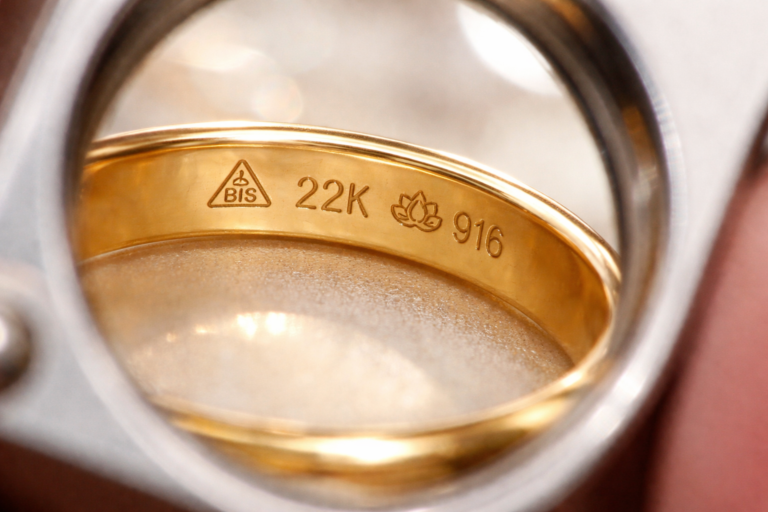
Buying gold is a big decision, and the small marks stamped on a piece tell you whether you can trust it. Learning to read the BIS hallmark before you pay is one of the simplest ways to protect yourself from fakes and low-purity gold. These tiny marks certify how pure your gold is, and checking them takes only a moment at the counter. This guide explains what each mark means and how to verify it with confidence.
Once you know what to look for, the whole process becomes second nature. You will be able to glance at a piece, read its marks, confirm them in an app, and buy knowing exactly what you are getting. It is a skill worth having, since you will use it every time you shop for gold, whether in a showroom or online.
Why Reading the BIS Hallmark on Gold Matters
Gold attracts imitation precisely because it is valuable. With prices high and more people buying online, pieces of doubtful purity reach the market, and buyers often discover problems only later, when colour fades or a resale jeweller questions the quality. Reading the hallmark upfront removes that risk before any money changes hands.
A BIS hallmark is not decoration. It is an official certification from the Bureau of Indian Standards confirming that the gold meets a stated purity. When you can read it yourself, you no longer rely on a seller’s word; you rely on a regulated mark backed by a verifiable code. That shift puts the power back in your hands as a buyer.
It also makes you a sharper shopper overall. Knowing the marks helps you compare pieces fairly, question anything that looks off, and walk away from a purchase that does not check out, all of which saves money and worry over time. The habit costs nothing and pays off on every single gold purchase you ever make.
What Is a BIS Hallmark?
The Bureau of Indian Standards runs India’s hallmarking system, which certifies the purity of gold jewellery. Since hallmarking became mandatory for most gold jewellery, a genuine piece should carry the BIS marks that prove it has been independently tested and certified. This shift was designed to protect ordinary buyers, who previously had little way to confirm purity for themselves.
In simple terms, a BIS hallmark gold piece has been assessed at an official assaying and hallmarking centre, not just stamped by the seller. The hallmark tells you the gold’s purity is what the jeweller claims, which is why it sits at the centre of any honest gold purchase. Without it, you have only a promise; with it, you have certification. That difference matters most for expensive pieces, where even a small gap between claimed and actual purity adds up to real money.
The 3 Parts of a BIS Hallmark You Should Check
A current BIS hallmark has three components. Learning to spot all three, rather than just one, is the key to reading gold correctly, since a single mark on its own does not tell the full story.
1. The BIS Logo
The first mark is the BIS standard mark, a small triangular logo. This is the symbol of the Bureau of Indian Standards and confirms the piece falls under the official hallmarking scheme. If this triangle is missing, the piece is not BIS hallmarked, whatever else it may show.
Look closely, since the mark is tiny and often placed on the inner surface of a ring or the clasp of a chain. A jeweller should be willing to point it out and let you examine it under magnification. If you struggle to find it, asking the seller to show you exactly where it sits is completely reasonable and expected.
2. The Purity Grade
The second mark shows the purity, expressed as a three-digit number tied to the karat. This tells you exactly how much pure gold the piece contains, which directly affects its value and price.
This is the part many buyers overlook, yet it is essential. Confirming the purity grade ensures you are paying the correct rate for the karat you are actually buying, rather than assuming all gold is equal. We will cover what each number means shortly, so you can match the mark to the price with confidence.
3. The HUID Number
The third mark is the HUID number, a six-character alphanumeric code unique to that specific piece. HUID stands for Hallmark Unique Identification, and it acts like an identity card for your jewellery, linking it to its certification records.
Because each HUID number is unique and registered, it is the part you can independently verify. This is what makes modern hallmarking so powerful: you are not just trusting a stamp, you are checking a code against an official database. The next section shows exactly how. Keeping a note of this code after purchase is also useful, since it ties the piece to its certification for any future resale or exchange.
How to Verify the HUID Number in the BIS Care App
Verifying the code is straightforward and free. Performing this gold hallmark verification before you pay is the single most reassuring step you can take, since it checks the piece against official records rather than relying on appearances alone.
- Download the BIS Care app from your phone’s official app store. It is published by the Bureau of Indian Standards and costs nothing.
- Open the app and find the option to verify a hallmarked product using its HUID.
- Enter the six-character HUID code exactly as it appears on the piece.
- Review the details the app returns, such as the jeweller and purity, and check that they match the item in your hand.
If the details match, you have strong confirmation the piece is genuinely hallmarked. If the code does not exist, or the details do not match the piece in front of you, treat that as a serious warning and do not proceed until it is explained. Doing this check at the counter, before payment, is far easier than trying to resolve a problem afterward.
How to Read Purity Marks
The purity grade is simple once you know the code. Each number reflects the proportion of pure gold in the piece, out of 1000.
- 916 means 22K gold, about 91.6 percent pure. This is the most common choice for traditional Indian jewellery.
- 750 means 18K gold, about 75 percent pure. The added alloy makes it more durable, which suits stone-set and daily-wear pieces.
- 585 means 14K gold, about 58.5 percent pure. It is harder still and less common for traditional jewellery.
Knowing these lets you match the mark to the price you are quoted. A piece stamped 750 should not be sold at a 916 rate, so reading the purity protects you from overpaying for lower-karat gold. It also helps you choose the right karat for the purpose, since higher purity suits traditional pieces while harder, lower-karat gold better withstands daily wear.
Red Flags to Watch for Before You Pay
A few clear warning signs should make you pause. Spotting them early saves you from a regretful purchase.
- No hallmark at all. If the piece carries no BIS triangle, purity grade, or HUID, there is no certification to rely on.
- A missing or unreadable HUID. The six-character code should be present and legible; its absence is a red flag.
- A mismatch in the app. If the BIS Care app shows details that do not match the piece, something is wrong.
- A reluctant seller. A trustworthy jeweller will happily show and explain the marks. Hesitation to do so is telling.
- A price that seems too good. Gold tracks daily market rates, so an unusually cheap deal often signals a problem with purity or authenticity.
If any of these appear, slow down and ask questions. A genuine seller will have clear answers, and the marks will hold up to scrutiny. There is never any harm in taking an extra minute to check before paying. Trusting your instincts here is wise, since a piece that cannot pass these simple checks is rarely worth the risk, however appealing it looks or however good the offer sounds.
Check the Right BIS hallmark
Reading a BIS hallmark before you pay is a small habit that delivers real protection. By checking the three marks, the BIS triangle, the purity grade, and the HUID number, and verifying that code in the BIS Care app, you can confirm exactly what you are buying. The system is designed to put certainty in your hands, and using it takes only moments.
Make these checks a routine part of every gold purchase. Look for all three marks, read the purity, verify the HUID, and watch for the red flags above. Do that, and you can buy gold with genuine confidence rather than crossed fingers. The few moments it takes are nothing beside the value of the piece you are protecting. When you want certified, properly hallmarked gold jewellery from a trusted name, Charvi Jewels makes every mark easy to read and verify.
Frequently Asked Questions
A current BIS hallmark has three parts: the triangular BIS logo, the purity grade as a three-digit number such as 916 or 750, and a six-character HUID code. Checking all three together, rather than just one, confirms a piece is genuinely hallmarked and certified.
Download the free BIS Care app from your official app store, open the HUID verification option, and enter the six-character code exactly as stamped on the piece. The app returns details such as purity and jeweller, which should match the item in your hand before you pay.
The mark 916 indicates 22K gold, meaning about 91.6 percent pure gold. It is the most common purity for traditional Indian jewellery. Other common marks include 750 for 18K gold and 585 for 14K, with the number always showing purity out of 1000.
Hallmarking has been made mandatory for most categories of gold jewellery in India, which is why genuine pieces should carry the BIS marks. Always confirm the marks are present and verify the HUID, since these prove the piece has been independently tested and certified rather than simply stamped.
The triangular BIS logo shows the piece falls under the official hallmarking scheme, while the HUID is a unique six-character code identifying that specific item. The logo signals certification in general; the HUID lets you verify that exact piece against official records in the BIS Care app.
Because each HUID is unique and registered in an official database, you can check it in the BIS Care app. A faked or copied code will either fail to appear or return details that do not match the piece. That mismatch is a clear warning sign to stop and ask questions.
Hallmarks are tiny and usually placed discreetly, such as inside a ring band, on a chain’s clasp, or on the inner edge of a bangle. Ask the jeweller to point them out, and use magnification if needed. A genuine seller will happily show you where the marks are.
Treat the absence of a hallmark as a serious caution. Without the BIS marks and a verifiable HUID, you have no independent proof of purity. It is safest to avoid unhallmarked gold and choose certified pieces from a trusted jeweller who makes the marks easy to check.
A hallmark does not fix a price, but it does make resale and exchange easier, since the next buyer can trust the certified purity. Hallmarked pieces, kept with their itemised bill, generally face fewer doubts and command fairer offers than unhallmarked gold of uncertain quality.
Yes. The BIS Care app is published by the Bureau of Indian Standards and is free to download and use. Beyond verifying a HUID, it lets you check hallmarking details and raise complaints, making it a useful tool for any gold buyer to keep on their phone.