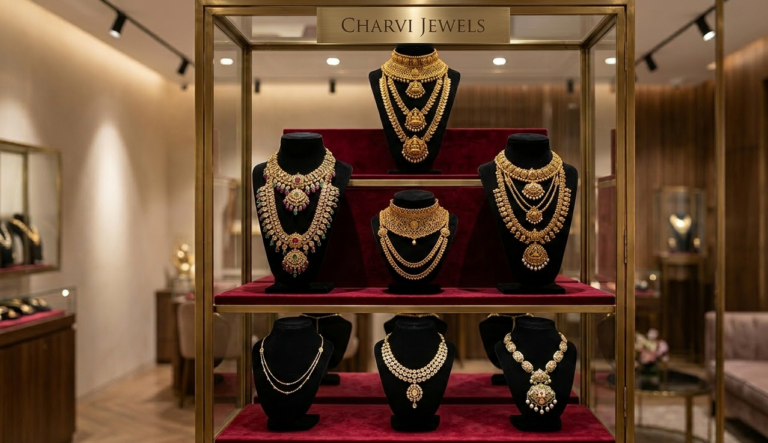
Your wedding day is perhaps the one moment in life when every detail feels sacred and nothing carries more weight than the gold jewellery for wedding you choose to wear. From the maang tikka to the toe rings, each piece tells a story of love, heritage, and personal style. But with so many stunning designs flooding the market in 2025, how do you decide what is truly on-trend and what will stand the test of time?
Whether you are a bride-to-be searching for the perfect wedding gold jewellery set, a mother selecting a meaningful gift, or a family member looking for the ideal bridal gold jewellery piece this guide is for you. We have curated the most sought-after design trends, expert styling tips, and buying advice to help you make a confident, beautiful choice.
Top 6 Gold Jewellery Design Trends for Brides in 2026
Here are the most in-demand gold wedding jewelry for bride styles this year each one striking
the perfect balance between heritage and modernity.
1. Layered Temple Jewellery Sets
South Indian goddess-inspired long harams & matching earrings timeless and deeply traditional.
2. Polki & Gold Fusion
Uncut diamonds set in 22K gold a regal, Mughal-era inspired look taking bridal runways by storm.
3. Minimal Gold Bridal
Dainty chains, sleek bangles, and delicate studs perfect for the contemporary bride who loves understatement.
4. Antique Meenakari Enamel
Vibrant enamel works on antique gold vivid colours that pop beautifully against red and ivory bridal outfits.
5. Choker + Layer Stacking
Mixing a fitted gold choker with longer chains creates a contemporary layered neck look with traditional roots.
6. Heritage Jadau Sets
Gem-encrusted Jadau gold handcrafted in the old Rajasthani tradition for a truly heirloom bridal look.
1. Layered Temple Jewellery Sets
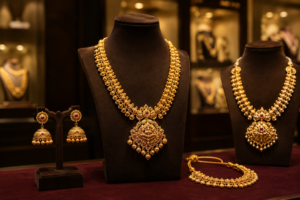
Temple jewellery is one of the most storied forms of gold jewellery for weddings in India, originally crafted to adorn the idols of deities in South Indian temples. Over centuries, this sacred art form transitioned from sanctuaries to bridal chambers and today it stands as the most sought-after wedding gold jewellery design for brides across Tamil Nadu, Kerala, Andhra Pradesh, and Karnataka. Each piece is a handcrafted narrative, featuring intricate depictions of Goddess Lakshmi, peacocks, lotus flowers, and temple gopuram motifs rendered in rich 22-karat gold.
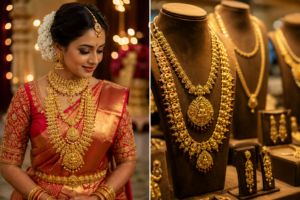
The hallmark of a temple jewellery set is its layered grandeur. A classic bridal set features a long Lakshmi haram as the centrepiece often complemented by a mid-length kasu mala (coin necklace) worn simultaneously for a dramatic stacked effect. Matching jimikki jhumkas or chandelier earrings frame the face, while a maang tikka, vanki armlet, and oddiyanam waist belt complete the ensemble. The depth, weight, and layering of this set creates an unmistakable regal presence that photographs with extraordinary beauty particularly against a rich Kanchipuram silk saree or a deep red Banarasi.
In 2025, temple gold jewellery designs has evolved beyond pure tradition. Leading jewellery houses are now offering fusion temple sets that blend classic motifs with lighter-weight construction, making them more comfortable for full-day wear. Brides are also customising temple pieces choosing their preferred deity motif, incorporating coloured stones like rubies and emeralds, or requesting oxidised finishes for a more antique aesthetic. Whether worn head-to-toe traditional or mixed with a contemporary outfit, layered temple jewellery remains the single most powerful statement a South Indian bride can make.
2. Polki & Gold Fusion Bridal Sets
Polki jewellery crafted from uncut, unpolished natural diamonds set directly into 22-karat gold is perhaps the most opulent expression of bridal gold jewellery available today. Rooted in the Mughal court traditions of the 16th century, Polki was once reserved exclusively for royalty and nobility. The distinctive characteristic of Polki is the raw, flat-faceted diamond that reflects light in a soft, candlelit glow rather than the sharp sparkle of cut diamonds giving the wearer an ethereal luminosity that is uniquely suited to the warm, golden atmosphere of wedding mandaps and photography lighting.
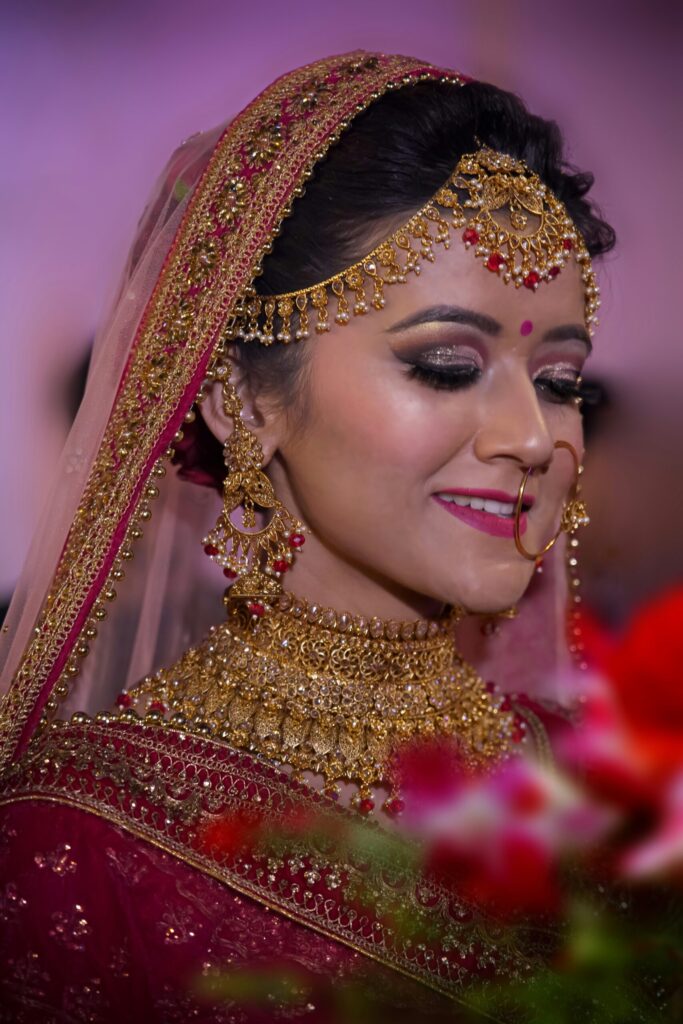
A full Polki bridal set typically includes a heavily ornate rani haar (long necklace), a choker layer, large statement earrings, maang tikka, passa (side headpiece), and wide kadas all set with dozens of uncut diamonds encased in gold foil (known as kundankari work). The interplay between the rough diamonds and the deep yellow of 22K gold creates a warmth and richness that no other jewellery form can replicate. In 2025, Polki-gold fusion sets are also featuring coloured stones, deep red rubies, Zambian emeralds, and Burmese sapphires embedded alongside the uncut diamonds for added vibrancy and personalisation.
What makes Polki-gold fusion the defining wedding gold jewellery design for brides of this decade is its perfect balance of heritage and exclusivity. Every Polki set is inherently unique; no two uncut diamonds are identical, making each bridal set a one-of-a-kind heirloom. For brides seeking grandeur that transcends trends, a Polki-gold fusion set is an investment not just in wedding-day beauty, but in a treasure that will be passed down through generations. It pairs magnificently with a heavily embroidered lehenga in ivory, blush, or red, and commands every room it enters.
3. Minimal Gold Bridal Designs for the Modern Bride
Not every bride wants to be draped in gold from collarbone to wrist and 2025 fully, beautifully celebrates that. The rise of the minimal gold bridal aesthetic represents a significant cultural shift: the modern bride’s confidence in letting her own presence, rather than the weight of her jewellery, command attention. This approach favours quality over quantity: a single, perfectly crafted 22K gold chain, diamond-cut bangles in a slim stack, small Kundan studs, and a delicate maang tikka that traces the hairline like a whisper rather than a declaration.
Minimal gold jewellery for bridal weddings works with a surprisingly wide range of outfits and settings. For destination weddings in Udaipur, Goa, or abroad, a minimal gold set travels beautifully and photographs elegantly against open-air, natural-light settings. For court marriages and intimate ceremonies, it strikes the perfect tone present and meaningful without being ostentatious. Even for traditional ceremonies, a curated minimal set pairs brilliantly with a heavily embroidered or textured lehenga, where the intricacy of the fabric is the visual anchor and the jewellery provides a warm, golden frame without distraction.
The key to executing a minimal gold bridal look is intentionality. Each piece must be chosen with precision a diamond-cut gold chain with a meaningful pendant, a slim mangalsutra with a refined design, or a single statement ring instead of stacked rings on every finger. In 2025, jewellers are offering personalized minimal bridal sets where brides can engrave initials, wedding dates, or coordinates into delicate gold pieces turning minimalism into intimate storytelling. The result is a bridal look that feels deeply personal, effortlessly modern, and timelessly beautiful.
4. Antique Gold Jewellery with Meenakari Enamel
Meenakari, the ancient Persian art of colouring the surface of metals through intricate enamel work, arrived in India via the Mughal courts and took deepest root in the royal ateliers of Jaipur. Today, Meenakari jewellery fused with antique-finish gold is experiencing a powerful renaissance as one of the most visually arresting gold jewellery for wedding trends of 2025. What sets Meenakari apart is the way vivid enamel pigments deep cobalt blue, forest green, saffron yellow, and Rajasthani crimson are hand-painted into recessed gold channels, then fired at high temperatures to produce colours of extraordinary permanence and depth.
The combination of antique gold (gold treated with an oxidised, slightly darkened finish) and Meenakari enamel is particularly powerful for bridal jewellery. The dark gold base makes the enamel colours appear even more saturated and vibrant. The effect is like stained glass set in bronze. For brides wearing red lehengas or sarees, deep blue and green Meenakari pieces create a stunning complementary contrast. For ivory or blush brides, pieces with warm saffron and ruby enamel add a burst of colour that elevates the entire look without requiring additional accessories. The most popular Meenakari bridal pieces in 2025 include oversized chandelier earrings, statement pendants on plain gold chains, and wide cuffs with floral enamel panels.
Beyond aesthetics, Meenakari jewellery carries profound artisanal value. Each piece is entirely hand-crafted by master artisans the meeankars who spend years perfecting the art of filling intricate gold cavities with enamel without overflow or imperfection. When you choose a Meenakari bridal gold set, you are not just purchasing jewellery, you are commissioning a work of art with centuries of craft heritage behind it. Brides who appreciate uniqueness, colour, and craft will find Meenakari antique gold jewellery to be among the most distinctive and conversation-worthy choices they can make for their wedding day.
5. Choker + Layered Necklace Stacking Style
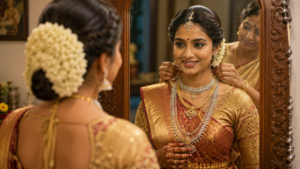
The choker and layer stacking trend is rewriting the rules of how brides wear gold and it is arguably the most versatile and democratically accessible wedding gold jewellery styling approach of 2025. At its heart, this trend involves wearing a close-fitting gold choker (sitting at or just above the collarbone) simultaneously with one or two longer necklaces of varying lengths, creating a cascading, multi-dimensional neck look. Unlike a traditional matching set, stacking allows brides to curate their own unique combination mixing different textures, finishes, and styles from across their existing jewellery or from separate purchases.
The styling rules of gold layering are elegantly simple: contrast is key. If the choker is heavily ornate a Kundan temple choker, a coin-studded band, or a wide Meenakari piece the layered necklaces below should be relatively simple: a plain gold chain with a single pendant, a slim diamond-cut chain, or a thin mangalsutra chain. Conversely, if the choker is a slim, minimalist band, the longer layers can afford to be bolder: a medium-weight antique gold chain or a delicate Polki pendant. The interplay of thick and thin, ornate and plain, close and long is what gives the stacked look its editorial, high-fashion quality while maintaining the warmth and richness of bridal gold jewellery.
What makes the choker-and-layer look particularly powerful for modern brides is its adaptability across all wedding functions and outfit changes. A bride can wear the full three-layer stack for the main ceremony, then remove the bottom layer for the reception for a slightly cleaner look, and wear just the choker alone for the honeymoon dinner. This multi-occasion flexibility makes the investment in separate pieces far more cost-effective than a single heavy matching set. In 2025, leading bridal gold choker necklace are now offering curated “stacking kits” pre-matched choker-and-necklace combinations designed to work together beautifully making it easy for brides to achieve the layered look without the guesswork.
6. Heritage Jadau Bridal Gold Sets
Jadau jewellery is one of the most ancient and revered forms of Indian bridal gold craftsmanship, a tradition born in the royal workshops of Rajasthan and Gujarat that has survived largely unchanged for over five hundred years. The defining technique of Jadau involves embedding precious and semi-precious gemstones, rubies, emeralds, sapphires, and pearls directly into molten gold without the use of mechanical prongs, settings, or adhesives. As the gold cools, it grips the stones in an organic, seamless embrace. The result is a piece where gold and gemstone appear to have grown together unified, inseparable, and breathtakingly intricate.
A full Jadau bridal set is among the most comprehensive and grand of all wedding gold jewellery sets for brides. It typically encompasses a heavily jewelled necklace (often in multiple layers), large statement earrings with cascading pearl drops, a maang tikka, passa, nath (nose ring), bangles, and finger rings all unified by the same gemstone palette and gold finish. The craftsmanship time for a single quality Jadau set ranges from several weeks to several months, and each artisan known as a jadiya is a specialist who has trained for years to master the fusion of metal and stone. This is not mass-produced jewellery; it is living heritage, made one stone at a time.
In 2025, heritage Jadau sets are experiencing renewed demand among brides who want their wedding jewellery to transcend the occasion and become a family heirloom. Unlike fashion jewellery, a well-made Jadau set retains both its material and artistic value across generations; grandmothers are passing their Jadau pieces to granddaughters, who wear them alongside contemporary outfits for a breathtaking clash of eras. Modern jewellers are also offering contemporary Jadau traditional techniques applied to lighter, more wearable designs that suit today’s brides who love heritage craft but prefer a less overwhelming weight. Whether grand or refined, a Jadau gold set is the ultimate statement that a bride’s jewellery is not just for the wedding it is forever.
Love our bridal style secrets? If this guide sparked some inspiration for your big day, we’d love to have you stay connected! Visit our website for more jewelry trends and styling tips. at Charvi Jewels in R.S. Puram, Coimbatore, we specialize in bringing these timeless stories to life with exquisite craftsmanship and heart. Visit us to discover the piece that will become a cherished part of your legacy forever.
FAQ
1. What is the most popular gold jewellery design for brides in 2025?
Layered temple jewellery sets and Polki-gold fusion bridal sets are the top trending wedding gold jewellery designs for brides in 2025. Temple sets featuring multi-strand harams and Lakshmi pendants lead among South Indian brides, while Polki-gold sets are the preferred choice for North Indian and destination weddings. Minimal gold bridal looks are also surging in popularity for contemporary brides.
2.Which karat gold is best for a wedding jewellery set?
22-karat gold is the most recommended choice for a bridal wedding jewellery set. It offers the ideal balance of purity, rich warm colour, and durability needed for intricate craftsmanship. 18-karat gold is a good alternative for diamond-studded pieces as it is harder and more scratch-resistant. 24-karat gold is the purest but too soft for detailed jewellery making and is better suited for gold coins or bars.
3.How do I style gold jewellery for a modern bridal look?
To achieve a modern bridal gold look, layer a fitted gold choker with one or two longer necklaces of varying lengths. Mix textures for example, pair an antique Meenakari pendant with polished gold bangles. Avoid wearing a perfectly matching set; instead, curate individual pieces from different collections. This creates an editorial, high-fashion bridal aesthetic that still honours traditional gold jewellery for weddings.
4.Can I wear minimal gold jewellery for a traditional Hindu wedding?
Yes, absolutely. Many modern brides choose a curated minimal gold bridal set for traditional Hindu weddings. A slim gold mangalsutra, small jhumkas, a delicate maang tikka, and a thin set of bangles create a graceful, understated look without sacrificing cultural significance. Minimal wedding gold jewellery designs for brides work particularly well with heavily embroidered lehengas or Kanchipuram silk sarees where the outfit itself is the statement.
5.How early should I shop for my bridal gold jewellery?
Ideally, begin shopping for your wedding gold jewellery set 3 to 6 months before your wedding date. This gives you sufficient time to explore design trends, compare jewellers, and place custom orders if needed, especially for intricate pieces like Jadau or Polki sets that require craftsmanship time. Shopping early also protects you from last-minute price pressures during peak wedding season between October and February.
6.What is the difference between Jadau and Kundan gold jewellery for brides?
Jadau and Kundan are both traditional Indian jewellery forms but differ in technique. Jadau involves embedding gemstones directly into molten gold without the use of prongs or adhesives; stones become permanently fused into the gold base. Kundan, on the other hand, uses refined gold foil (Kundan) to set stones in a lac base. Jadau is generally considered more intricate, durable, and valuable, making it the preferred choice for heirloom bridal gold jewellery sets. Kundan is lighter and more affordable, while still offering a regal bridal look.
7.How much should I budget for a complete bridal gold jewellery set?
The budget for a complete wedding gold jewellery set for a bride can range widely. A basic 22K gold set with necklace, earrings, and bangles typically starts from ₹1.5 to ₹3 lakhs in India, while a mid-range Polki or Meenakari bridal set can cost ₹5 to ₹10 lakhs. Heritage Jadau or fully customised temple jewellery sets for brides can go well above ₹15 lakhs. A practical approach is to allocate your budget across key pieces: a statement necklace, earrings, maang tikka, and bangles rather than buying a single expensive set, for greater styling flexibility across multiple wedding events.
8.What gold jewellery is essential for a South Indian bride?
A traditional South Indian bride’s gold jewellery typically includes several essential pieces: a long haram (temple necklace) or Lakshmi haram, a kasu mala (coin necklace), large gold jhumkas, jimikki earrings, gold bangles and kadas, a vanki (armlet), gold waist belt (oddiyanam), and gold toe rings. Many South Indian brides also wear a maang tikka and gold nose ring. The wedding gold jewellery set for a South Indian bride is characterised by intricate temple motifs, peacock designs, and goddess imagery typically crafted in 22-karat gold.
9.How do I verify the purity of gold jewellery before buying it for a wedding?
Always look for the BIS (Bureau of Indian Standards) Hallmark when purchasing gold jewellery for weddings. The BIS Hallmark includes the BIS logo, the karat purity mark (e.g., 22K, 18K), the assaying centre’s mark, and the jeweller’s identification mark. Since April 2023, India has made 6-digit HUID (Hallmark Unique ID) mandatory on all hallmarked jewellery. You can verify the gold’s purity instantly by entering the HUID on the BIS Care app or website. Never purchase bridal gold jewellery without a valid BIS Hallmark certification.
10.Can I mix and match different gold jewellery styles for my wedding functions?
Yes, mixing and matching gold jewellery styles across different wedding functions is not only acceptable but is one of the biggest bridal styling trends in 2025. For the mehendi, opt for lightweight antique gold bangles and small jhumkas. For the sangeet, try bold temple necklace sets with matching chandelier earrings. For the main wedding ceremony, bring out your heaviest gold jewellery for the bride whether that is a Polki set, a Jadau necklace, or a full South Indian temple jewellery ensemble. Reserving your statement pieces for the primary wedding ritual ensures maximum impact and photography impact.