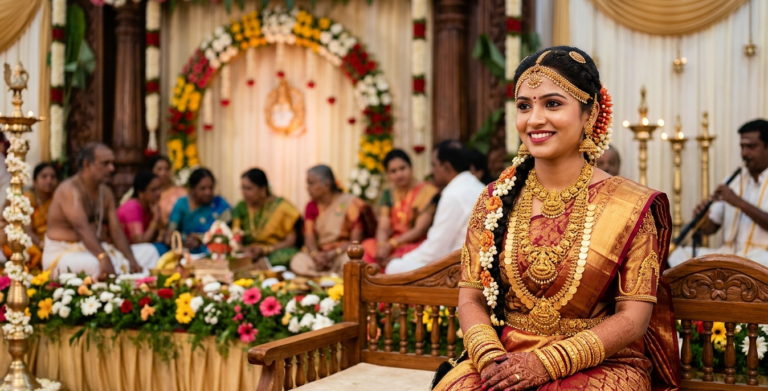
Every bride in Coimbatore knows that gold is not just a metal. It is a promise. It is the shimmer in your wedding photographs that your grandchildren will look at one day. It is the weight on your wrist that tells the world you are a bride. But here is a question that confuses so many families right before the big day: should you go with 18K gold or 22K gold for your Wedding Gold Jewellery? Both are real gold. Both are beautiful. Yet they are very different in ways that matter deeply when you are making a once-in-a-lifetime purchase.
This blog is written to help you understand those differences clearly, without confusing terms or complicated charts. By the time you finish reading, you will know exactly which gold suits your wedding best.
Understanding the Basics Before You Choose Gold Jewellery for Wedding
Before comparing 18K and 22K gold, it helps to understand what these numbers actually mean. Many brides assume that higher karat always means better gold. That is partly true, but the full picture is a little more interesting.
Gold in its pure form is 24 karats. Pure gold is very soft. It bends, scratches, and loses its shape easily. That is why jewellers mix it with other metals like copper, silver, or zinc to make it stronger and more wearable. The karat number tells you how much pure gold is in the mixture.
What 22K Gold Means
22K gold contains 22 parts pure gold and 2 parts other metals. In percentage terms, that is about 91.6% pure gold. This makes 22K gold rich in colour, naturally warm and yellow, and very close to the look of traditional pure gold. It is the most commonly used gold for traditional South Indian bridal jewellery.
What 18K Gold Means
18K gold contains 18 parts pure gold and 6 parts other metals. That works out to 75% pure gold. The higher proportion of other metals makes 18K gold harder and more durable. It also opens the door to a wider range of colours, including rose gold and white gold, because the added metals can shift the final colour.
Why This Matters for Your Wedding
When you are buying wedding gold jewellery for bride, purity is one of the most important factors. Here is a simple breakdown to help you see the difference at a glance:
- 22K gold: 91.6% pure, warmer yellow colour, softer, more traditional
- 18K gold: 75% pure, slightly lighter in tone, harder, more modern
- Both carry hallmark certifications from BIS (Bureau of Indian Standards) when purchased from a trusted jeweller
The difference in purity also affects price. Since 22K has more gold content, it will generally cost more per gram than 18K gold. However, the making charges and design complexity also play a big role in the final price of any piece.
Understanding these basics will help you have a more confident conversation when you walk into a jewellery store. When you visit a trusted place for wedding gold jewellery in Coimbatore, the jeweller can guide you further once you know what you are looking for.
The Look and Feel of 22K Gold for a South Indian Bride
If you have ever seen a Tamil or Telugu bride on her wedding day and admired the deep golden glow of her jewellery, you were most likely looking at 22K gold. There is a reason it has been the gold of choice for South Indian brides across generations. The colour, the weight, and the cultural significance of 22K gold make it almost irreplaceable in traditional wedding settings.
The Colour That Defines Tradition
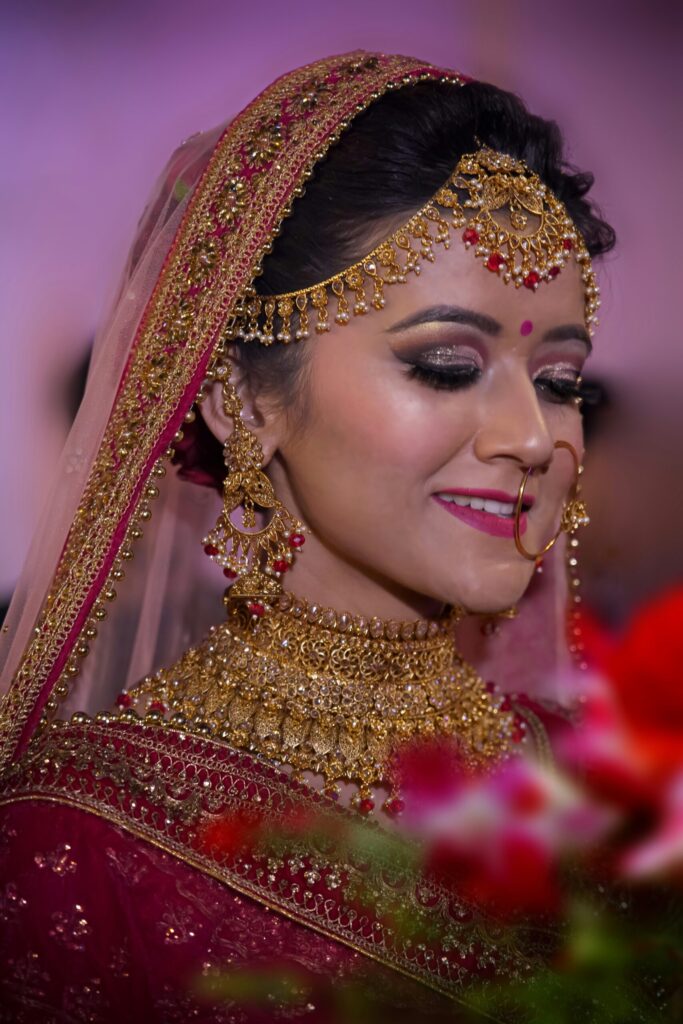
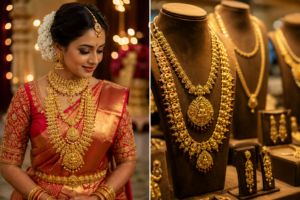
22K gold has a naturally rich, warm yellow tone that photographs beautifully under both natural light and artificial lighting. In a silk saree setting, particularly against a Kanjivaram or a Coimbatore silk saree, the warmth of 22K gold creates a visual harmony that feels timeless. It does not look pale or dull. It looks like gold is supposed to look.
This colour depth is especially important for pieces like:
- Vanki (armlet): The curves and engravings catch the light better in 22K
- Manga mala and lakshmi haar: The intricate temple work patterns are more defined in softer gold
- Kamarbandh (waist belt): Worn close to silk fabric, the warmth of 22K gold complements deep reds and greens beautifully
- Jhumkas and chandbaalis: The weight and drop of 22K earrings gives them a natural elegance
Traditional Jewellery Works Best in 22K
Many bridal jewellery designs, especially those with temple motifs, peacock patterns, and coin work, are crafted in 22K gold because the metal is easier to work with for detailed hand craftsmanship. Skilled artisans can carve finer details into 22K gold compared to harder metals.
Gold jewellery for bridal sets in traditional designs almost always use 22K gold because of this flexibility. Whether it is a full bridal set from a Coimbatore jeweller or a family heirloom being remade, the traditional look is best preserved in 22K.
The Emotional Weight of 22K Gold
In many Coimbatore families, wedding gold is not just bought. It is accumulated over years. Grandmothers save, mothers add to it, and brides receive it on their wedding day. Most of this gold, passed down through generations, is 22K. When you wear 22K gold jewellery at your wedding, you are not just wearing metal. You are wearing memory, love, and continuity.
For brides who want to honour their roots and wear something that feels deeply connected to South Indian tradition, 22K gold is almost always the right answer.
When 18K Gold Makes More Sense for the Modern Bride
Not every bride is planning a traditional ceremony from start to finish. Many weddings today in Coimbatore blend tradition with modern style. There is a mehndi function that calls for something light and fun. There is an engagement ceremony that asks for something elegant and minimalist. There is a reception that calls for something glamorous. For these occasions, 18K gold often fits the moment better.
Durability Is a Real Advantage
Because 18K gold has a higher proportion of other metals mixed in, it is noticeably harder than 22K gold. This makes it more resistant to everyday wear, scratches, and bending. For brides who plan to wear their jewellery regularly after the wedding, not just on special occasions, 18K gold holds its shape and surface quality much longer.
This is particularly relevant for:
- Rings: Everyday wear means constant contact with surfaces, water, and friction. 18K rings last longer without losing their shine.
- Bracelets: Worn daily, a 22K bracelet can develop small dents over time. An 18K bracelet is less likely to.
- Pendants with chains: For daily wear after the wedding, 18K chains do not kink or break as easily.
Design Possibilities That 22K Cannot Offer
18K gold opens up a world of design possibilities that 22K simply cannot match. Because of its hardness, 18K gold can hold intricate settings for diamonds and coloured stones far more securely. This is why diamond jewellery is almost always set in 18K or even 14K gold.
Wedding gold jewellery for bride sets that include diamond-studded pieces, for instance, are almost always made in 18K because the prongs and settings need to grip stones firmly without bending. A 22K gold prong is soft and may loosen over time.
Additionally, rose gold and white gold are both 18K variations. If a bride wants a non-traditional look with a rosy blush tone or a silvery-white finish, she is choosing 18K gold in a different alloy combination.
Price Can Work in Your Favour
Since 18K gold has less pure gold content per gram, it is generally priced lower than 22K gold on a per-gram basis. For brides who are building a large jewellery collection for multiple events, choosing 18K for some pieces can help manage the overall budget without compromising on beauty.
Many families in Coimbatore choose a mix: 22K for the core traditional pieces and 18K for the diamond sets and modern-style jewellery. This approach gives you the best of both worlds.
When you explore wedding gold jewellery in Coimbatore, a good jeweller will never push you toward one karat blindly. They will ask about your events, your style, and your budget before recommending the right mix.
Comparing Price, Purity, and Practicality for Your Wedding Budget
One of the biggest decisions any family makes during wedding planning is about budget. Gold jewellery is a significant investment, and understanding how karat affects price will help you plan smarter. This section breaks down the financial side in simple terms so you can allocate your budget wisely.
How Purity Affects Price Per Gram
As mentioned earlier, 22K gold has more pure gold content than 18K gold. Since gold is priced based on its purity and the current market rate, 22K gold will always cost more per gram than 18K gold on a given day.
Here is a simplified way to think about it:
- If the gold rate is Rs. 6,000 per gram for 24K pure gold on a given day
- 22K gold would be priced at approximately 91.6% of that, meaning around Rs. 5,496 per gram (before making charges)
- 18K gold would be priced at approximately 75% of that, meaning around Rs. 4,500 per gram (before making charges)
This difference adds up quickly when you are buying multiple sets of jewellery.
Making Charges Matter as Much as Gold Rate
Many brides focus only on the gold rate and forget about making charges. Making charges are what jewellers charge for the labour, design, and craftsmanship that goes into each piece. For highly detailed traditional designs, making charges can sometimes equal or even exceed the cost of the gold itself.
18K gold pieces with complex diamond settings often have high making charges because of the precision required. On the other hand, simpler 22K pieces with clean finishes may have lower making charges. Always ask for making charges to be quoted separately when you go jewellery shopping.
Resale and Exchange Value
This is a topic many brides and families do not discuss until later. If you ever want to exchange old jewellery for new designs, the resale value matters.
- 22K gold typically retains a higher resale value because of its higher gold content
- 18K gold also has a buyback value, but it is proportionally lower because of the reduced gold purity
- Reputed jewellers will always offer a fair buyback based on the current gold rate and purity
Gold jewellery for bridal collections that are bought from certified jewellers with BIS hallmarks will always have transparent resale processes. Always buy from a jeweller who clearly displays the hallmark certification on every piece.
Planning a Budget That Covers Both
A practical approach many Coimbatore families use is to plan their jewellery budget in two categories:
- Heirloom and traditional pieces: Buy in 22K for maximum purity, emotional value, and resale value. This includes the thali, bangles, necklaces, and traditional sets.
- Modern and occasional-wear pieces: Buy in 18K for better durability and design versatility. This includes diamond rings, pendant sets, and reception jewellery.
This dual approach lets you honour tradition while being practical about everyday wearability and long-term value.
How to Make the Final Decision on the Right Gold for Your Wedding
By now, you have a clear picture of both options. 22K gold is rich, traditional, and deeply connected to South Indian bridal culture. 18K gold is durable, versatile, and ideal for modern designs and diamond-studded pieces. So how do you make the final call?
The answer is not always one or the other. Most Coimbatore brides end up choosing a thoughtful combination of both. Here is a simple framework to help you decide.
Ask These Questions Before You Shop
- What ceremonies am I buying jewellery for? If it is primarily for the wedding and muhurtham, lean toward 22K. If it includes reception, engagement, and daily wear after the wedding, include some 18K.
- Do I want diamond-studded pieces? If yes, those must be in 18K.
- How often will I wear this jewellery after the wedding? Daily wear favours 18K. Occasional wear favours 22K.
- What is my total budget? A higher budget allows you to invest in more 22K. A tighter budget may call for selective use of 18K without compromising on beauty.
- What does my family tradition say? In many families, the thali and key pieces have always been 22K, and that tradition is worth honouring.
The Role of the Right Jeweller
No blog can replace the guidance of a knowledgeable jeweller who sits with you, understands your requirements, and helps you see real designs in both karats side by side. This is why choosing the right jewellery store matters as much as choosing the right karat.
When you look for gold jewellery for bridal sets that perfectly balance tradition and modern taste, you need a jeweller who listens before they suggest. At Charvi Jewels in R.S. Puram, Coimbatore, the team takes time to understand every bride’s unique vision. They do not offer a one-size-fits-all answer. They offer personalised guidance based on your events, budget, and style.
What South Indian Wedding Traditions Tell Us
In a traditional Coimbatore wedding, certain jewellery pieces carry ritual significance. The thali chain, for example, is almost always made in 22K because it is worn for life. The vanki worn during muhurtham is also typically 22K. These pieces are not just decorative. They carry spiritual and cultural meaning that demands the highest purity.
For all other pieces, especially those added for reception, engagement, or other functions, the decision can be more flexible. Many brides choose to invest in a beautiful 22K core set and then add 18K diamond pieces for the modern functions.
A Final Word on Hallmarking
Regardless of whether you choose 18K or 22K, always insist on BIS hallmarked jewellery. The hallmark confirms that the gold purity you are paying for is exactly what you are getting. Trusted jewellers who offer wedding gold jewellery in Coimbatore will always provide hallmarked pieces with a detailed bill that mentions karat, weight, and making charges separately.
Buying hallmarked gold protects your investment and gives you peace of mind, knowing that your wedding jewellery is as pure as it is beautiful.
Your wedding jewellery is more than gold. It is the story of your family, your love, and the new life you are about to begin. Whether you choose the warm richness of 22K for your traditional sets or the refined strength of 18K for your modern pieces, every choice you make deserves to be made with confidence and care. Take your time. Ask questions. Trust your instincts. And surround yourself with people who genuinely want to see you shine on your wedding day. If you loved what you read, book your appointment at Charvi Jewels, R.S. Puram, Coimbatore, and let us be part of your most beautiful chapter.
Frequently Asked Questions
- For traditional South Indian wedding jewellery, 22K gold is generally the preferred choice because of its rich colour and high purity. However, for diamond-studded pieces or modern designs, 18K gold works better. Most brides choose a mix of both.
- Yes, absolutely. Many Coimbatore brides use 22K for their traditional core pieces like necklaces, bangles, and thali, and choose 18K for diamond rings and reception jewellery. There is no rule that says you must stick to one karat for everything.
- 18K gold is harder and more durable for everyday wear because it contains a higher proportion of alloy metals. If you plan to wear your jewellery daily after the wedding, pieces like rings and chains in 18K will hold up better over time.
- Yes. Since 22K gold has more pure gold content, it costs more per gram compared to 18K gold. However, making charges also affect the final price, so always ask for a detailed breakdown before buying.
- Yes. 22K gold generally has a higher resale value than 18K because of its greater purity. When you exchange or sell your jewellery at a reputed jeweller, the buyback price is calculated based on current gold rates and the karat of your gold.
- Technically yes, but it is not recommended. 22K gold is softer, which means the prongs holding diamonds in place may loosen over time. Most jewellers set diamonds in 18K gold because it is harder and grips stones more securely.
- Always look for the BIS hallmark on every piece of jewellery. The hallmark confirms the purity of the gold. Reputed jewellers will also provide a detailed bill mentioning the karat, weight, and making charges separately.
- No. Rose gold and white gold are made by mixing gold with specific alloys like copper or palladium. These variations are always in 18K gold. If you want rose gold or white gold jewellery, you will be choosing 18K.
- For a wedding ring meant for daily wear, 18K gold is a better choice. It is harder, more scratch-resistant, and will maintain its shine through regular use. 22K gold rings can develop small surface marks over time with daily wear.
- Yes, most reputed jewellers in Coimbatore offer custom-made jewellery in both 18K and 22K gold. You can bring your design references or choose from the jeweller’s collection and have pieces crafted specifically for your wedding.